
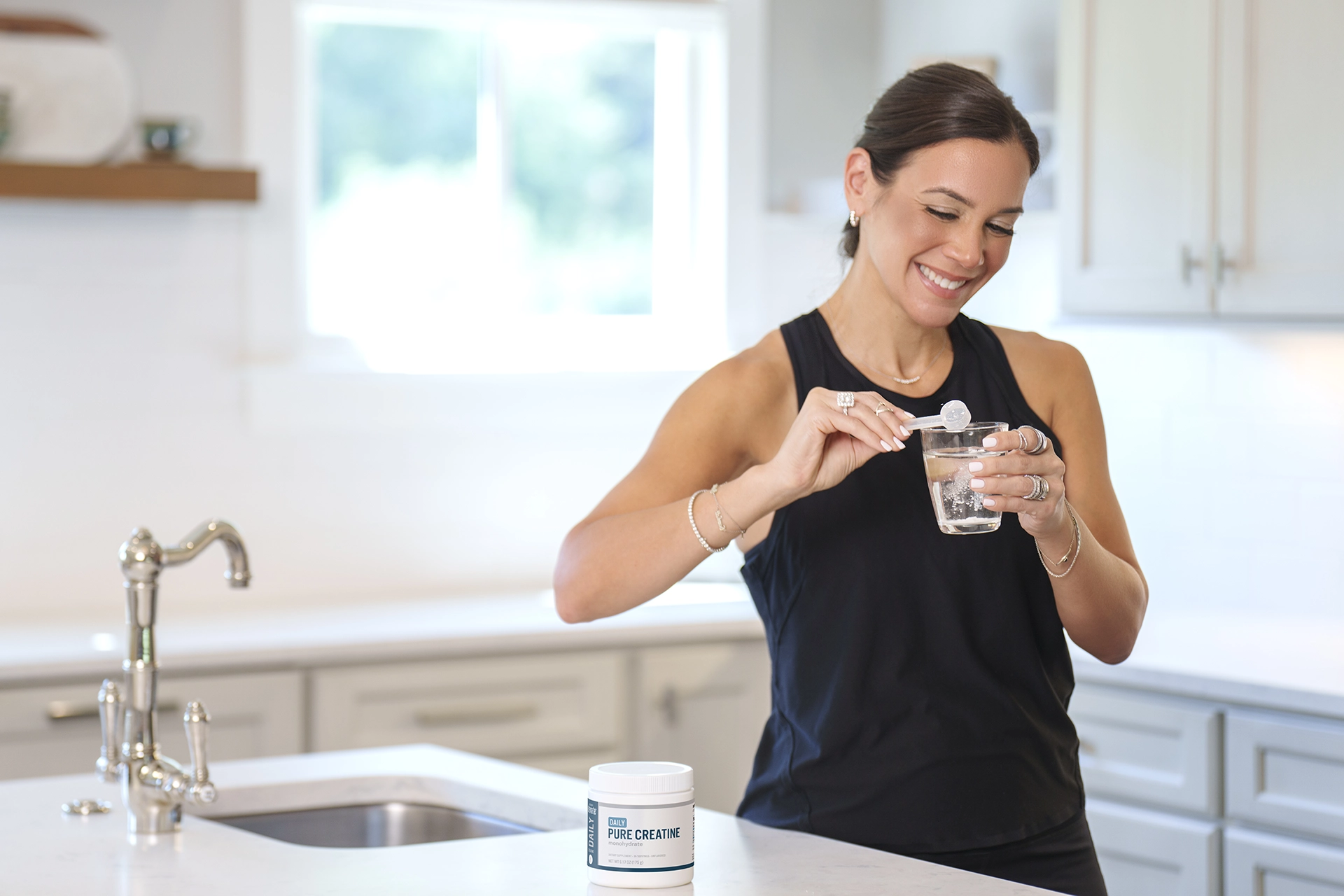
For decades, creatine has been one of the most tested and trusted supplements for building strength and supporting muscle growth. But now, scientists have discovered its power extends far beyond the gym.
Creatine isn’t just for athletes anymore. It’s for anyone who wants to think clearly under stress, preserve muscle as they age, and keep the energy to live life fully. And for women, new research is uncovering unique benefits—from maintaining strength to supporting cognitive function and mood through life’s hormonal transitions.
Your Energy Backup System: How Creatine Keeps Your Cells Fully Charged
Think of creatine as your body’s rechargeable energy reserve. Every cell uses it to power movement, focus, and recovery. Inside your muscles and brain, creatine helps regenerate ATP—adenosine triphosphate, the molecule that fuels nearly every heartbeat, thought, and muscle contraction. When ATP runs out, energy stalls. Creatine’s job is to recycle it—fast.
You naturally make about half of what you need in your liver, kidneys, and pancreas. The rest comes from food—mostly meat and fish. But even balanced diets usually supply only one to two grams a day. Research shows that’s enough to fill about 60 to 80 percent of your body’s creatine stores, leaving a daily energy gap of roughly 20 to 40 percent.
That’s why scientists call creatine a “conditionally essential” nutrient: your body can make some, but not always enough to meet real-world demands. Stress, aging, intense exercise, or simply too little sleep all draw down your reserves.
More Than Muscle—New Thinking for an Old Favorite
or decades, creatine studies focused on muscle fibers. But brain cells run on the same energy chemistry—and recent research shows that when creatine stores are topped off, the benefits reach far beyond physical strength. It’s now being studied for its potential to support mood, memory, and focus under pressure.
For years, the “rule” was simple: about five grams a day—enough to fuel short bursts of exercise and help muscles recover. That’s still true. But newer research suggests that when creatine levels are pushed closer to full saturation—the upper end of what the body can safely store—the benefits reach further.
In short-term research settings, higher intakes—typically 10 to 20 grams for brief periods—have been shown to raise creatine in the brain by up to 10 percent. Those higher levels have been linked with sharper thinking under stress, steadier mood in women during hormonal changes, and better outcomes in aging adults combining creatine with light resistance training.
Safe, Simple, and Backed by Decades of Data
With more than a thousand peer-reviewed studies, creatine remains one of the most researched nutrients in modern science. The consensus is clear: creatine monohydrate is safe for healthy adults, even when taken in short higher-dose phases that bring the body’s stores closer to full saturation.
Today, researchers describe creatine not just as a performance supplement but as a foundational wellness nutrient.
Creatine remains the gold standard for building strength, power, and performance in the gym. But for women, supplementing with creatine—and in some cases, at slightly higher daily doses than traditionally used—may help support strength, and cognitive resilience through life’s hormonal changes.
As with any supplement, it’s important to choose a trusted source that ensures purity, potency, and consistency like Vitality Elevate Pure Creatine. Because after three decades of research, one truth remains: when your cells have the right quality fuel, your body and mind simply work better.